
Supreme Court Hears Challenge to Immigration Enforcement Protocol
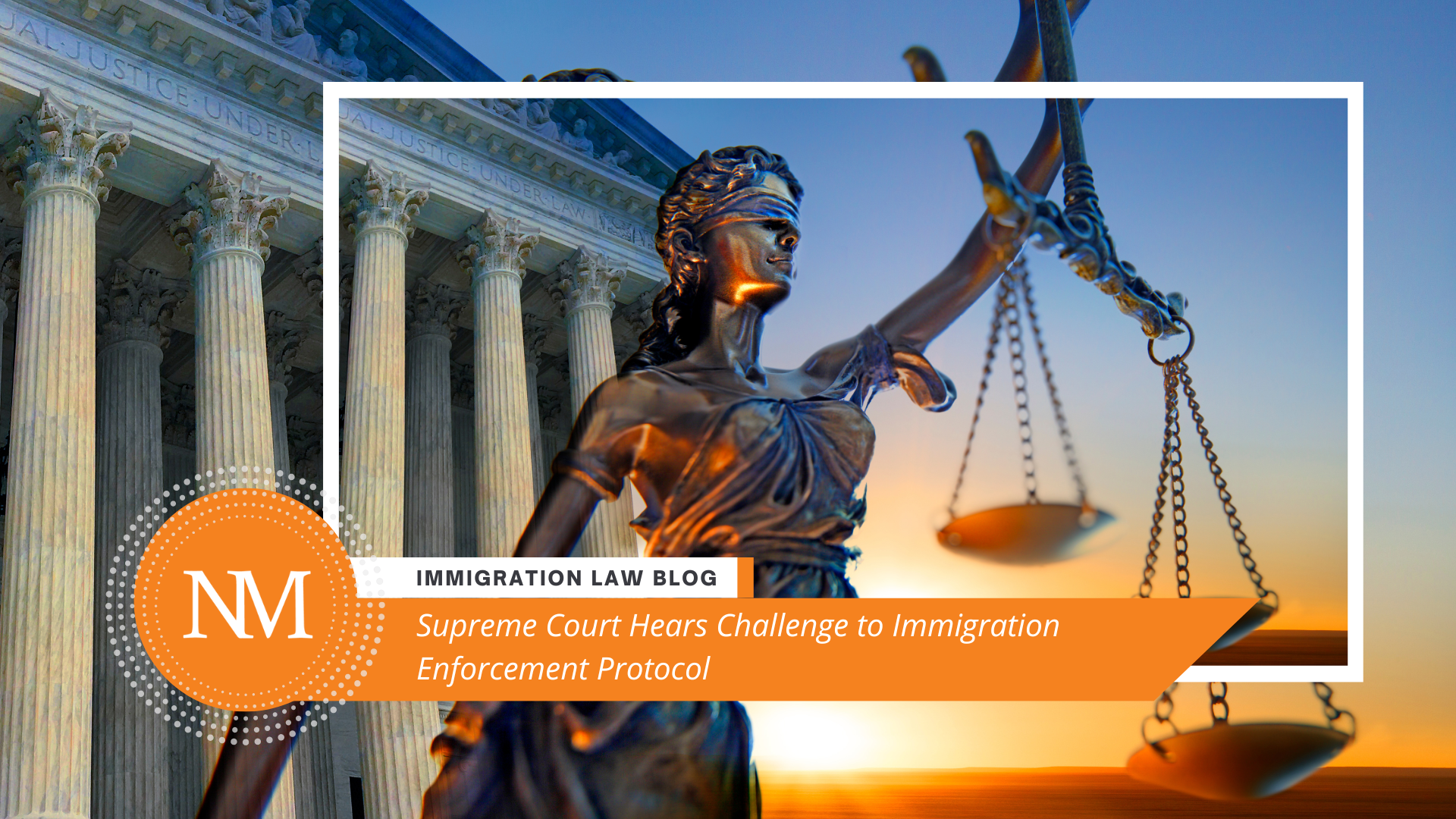
Once again, immigration policy finds itself in the spotlight, as the United States Supreme Court recently heard oral argument for United States v. Texas, a challenge to federal policy governing federal immigration enforcement policies. The lawsuit, brought by Texas and Louisiana, not only impacts the future of immigration enforcement in the country but also may impact the right of states to sue the federal government over discretionary policies. Experts agree the outcome of this case will impact immigration law for many years to come.
The Mayorkas Memorandum – An Unlawful Exercise of Discretion?
At the center of the challenge is a memorandum issued by Department of Homeland Security (the “Department” or “DHS”) Secretary Alejandro Mayorkas in September of 2021. The memorandum outlines the enforcement priorities for the Department, explaining that given the number of undocumented persons in the United States, established guidelines must govern the priorities for immigration enforcement. While the memorandum is extensive, the general principles are that those who are 1) a threat to national security, 2) a threat to public safety, or 3) a threat to border security would be prioritized for purposes of removal. These guidelines reflect the enforcement priorities in place under the Obama administration.
Southern States Challenge Mayorkas Memorandum
Shortly after the release of the Mayorkas Memorandum, Texas and Louisiana filed a federal lawsuit, challenging the guidance as a violation of federal law. Put simply, the lawsuit alleges that federal law requires the Department to detain and deport more noncitizens than the guidance suggests, and the ability to exercise prosecutorial discretion to choose who to prioritize for deportation is unlawful. A District Court Judge in the 5th Circuit agreed with the states’ arguments and vacated usage of the Mayorkas memorandum by the Department.
Following this decision, the Biden administration sought the U.S. Supreme Court’s intervention to freeze the order, but the Supreme Court declined to do so by a 5-4 vote. The Court did, however, agree to hear the case. The Court recently heard oral argument, and the case now awaits formal decision by the Court.
U.S. Supreme Court Hears Key Immigration Case
The Supreme Court justices asked the parties to address three questions. First, the parties were to discuss the issue of standing and whether states have a legal right to bring the lawsuit. The Biden administration argues they do not, explaining that the states incurred no injury because of the federal government’s actions. The Southern states, however, maintain that the presence of additional noncitizens in their states results in additional costs, forming the basis for standing in the lawsuit.
The second question is whether the Mayorkas Memorandum is consistent with federal immigration law and law governing administrative agencies. At the heart of this question is whether the Department, through its exercise of established prosecutorial discretion guidance, can choose not to remove someone from the country even if federal law requires their removal. At the heart of this argument is the concept of “prosecutorial discretion,” which allows law enforcement to strategically utilize its resources to address the greatest threats it faces. Of course, the Biden administration maintains that prosecutorial discretion is foundational to immigration enforcement, and any other interpretation of federal law would be unprecedented and unfeasible.
Finally, the parties will address the question of whether a federal judge has the power to set aside a policy like the Mayorkas Memorandum. The Biden administration maintains that only the U.S. Supreme Court has such authority, while the states argue that federal law governing administrative agencies allows courts, including federal district courts, to set aside agency action that fails to comply with federal law.
The case involves a political scene in which the Biden administration is pitted against a historically conservative court. While some suggest the case involves political maneuvering by Southern states, the outcome of the case will impact not only immigration law, but the power of states to challenge federal immigration policy. A ruling in the case is expected before June.
To learn more about this blog post or if you have any other immigration concerns, please feel free to contact me at rglahoud@norris-law.com or (484) 544-0022.